Green storage is sized by the wind park. Grey storage is sized by the market.

Green storage is sized by the wind park. Grey storage is sized by the market.
Next to a wind park, the wrong battery storage is worse than none.
Large-scale standalone BESS in Germany are moving to longer durations. Germany's largest battery storage project under construction, BW ESS in Klostermansfeld, is planned with 1 GW and up to 5,7 GWh, and according to Ember, four hours is expected to become the standard across Europe. For a co-located green BESS, that would be the wrong decision. In our case study with Fluence, a 4 h green battery leaves the project worse off than no storage in 4 of 5 price scenarios.
We simulated 25 storage sizes for a 25 MW wind park, from 20 to 120% of the grid connection and from 2 to 8 hours. The right size depends on whether the battery is green or grey.
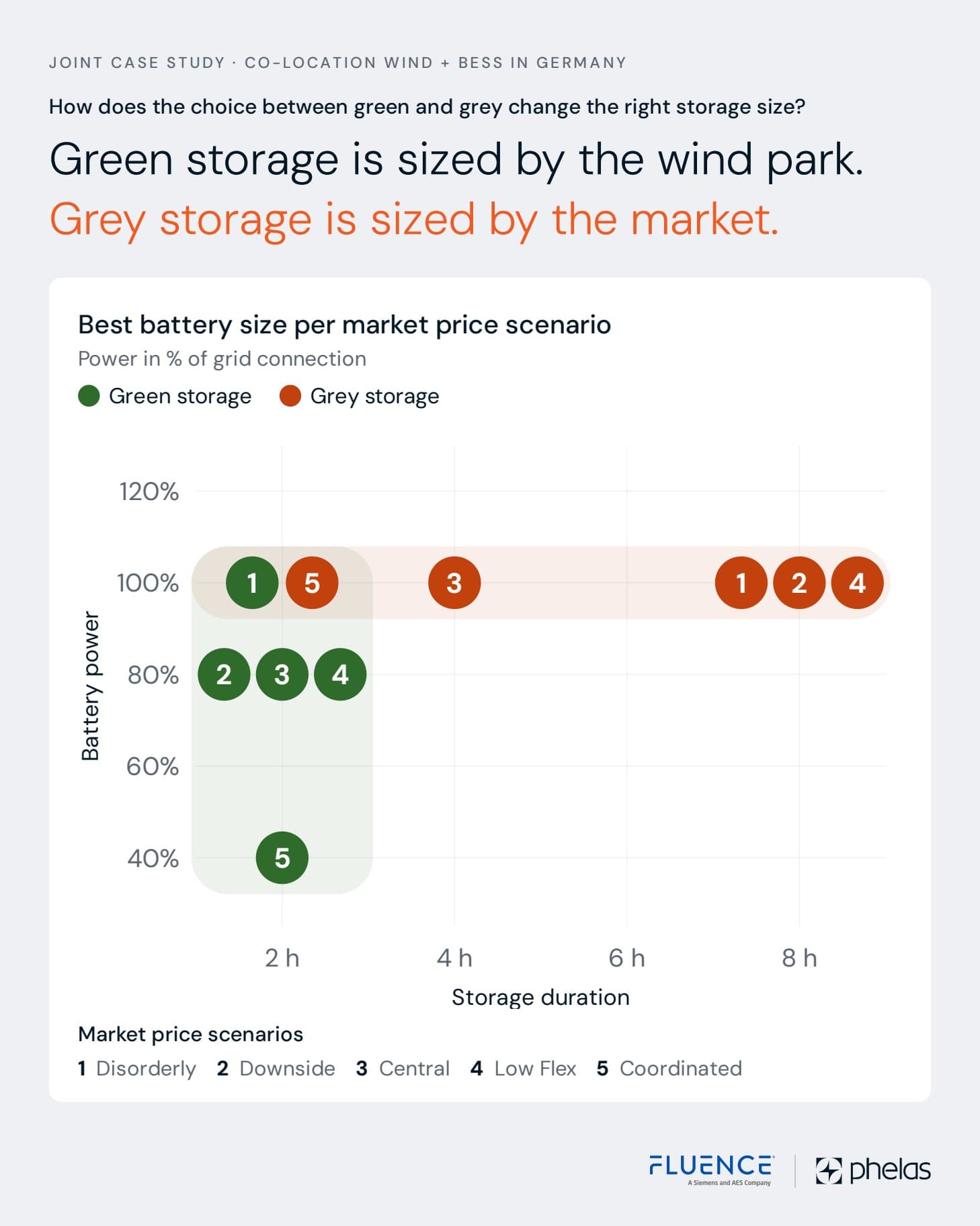
Green storage ends up at 2 hours in every scenario. Longer durations earn far less, because there isn't enough cheap surplus wind to fill them. Only the power changes with the price scenario, between 40 and 100% of the grid connection.
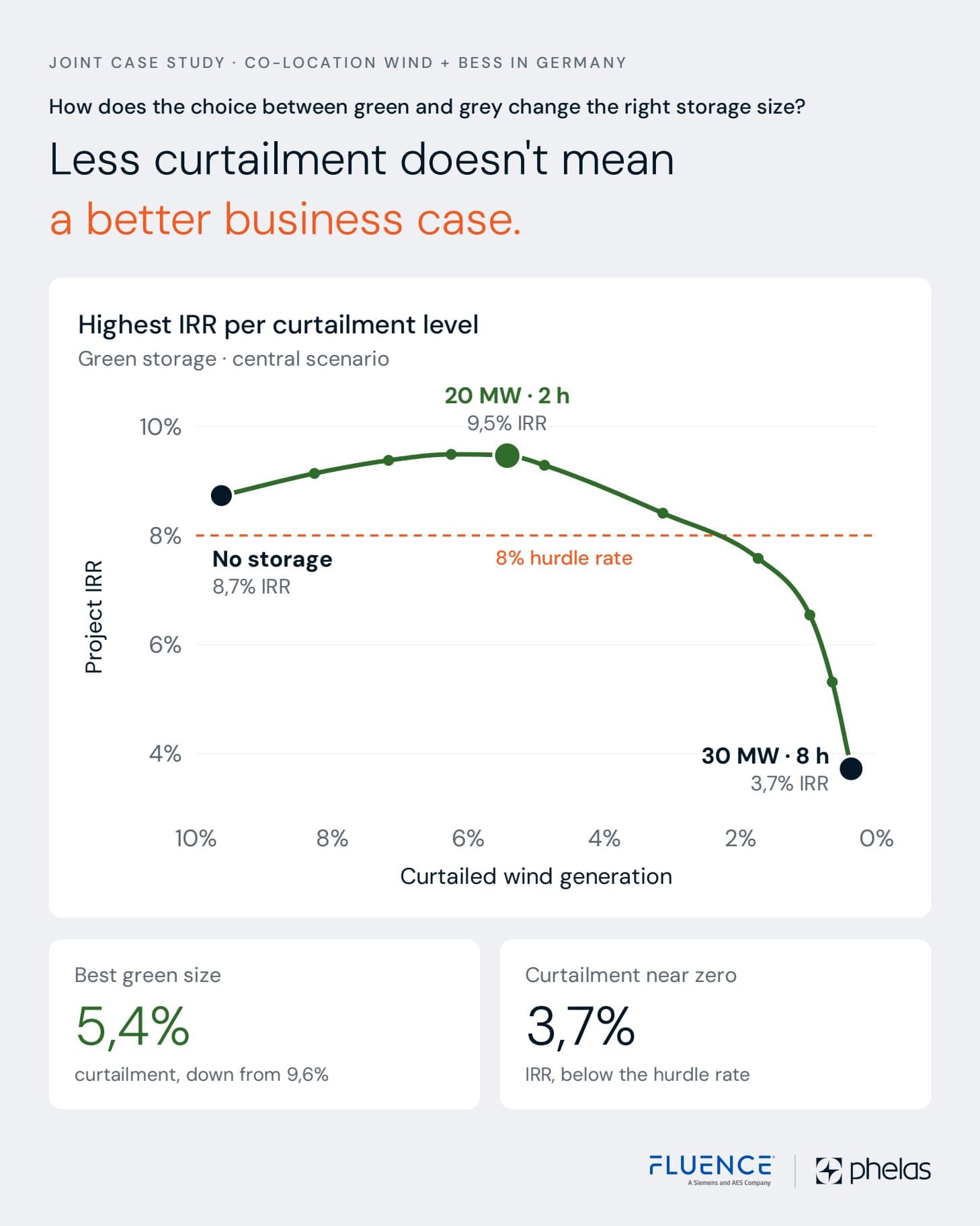
This also means that some curtailment is part of the optimum. A bigger battery could take in more of the curtailed wind, but at the assumed prices the extra capacity doesn't pay for itself. In our central scenario, the best green battery still accepts about 5% curtailment. Pushing it close to zero with 30 MW and 8 hours drops the project IRR from 9,5% to 3,7%, well below the 8,7% of the wind park on its own.
Grey storage can also charge from the grid, so the market sets its size. Its power always matches the grid connection. More power doesn't help, because the battery can't import or export more than the connection allows. Less power would mean giving up revenue, because the battery can trade all year, not only when the wind blows.
Its duration depends on the price scenario. When low prices occur often, a longer battery can be filled more often and the extra hours pay off. In our scenarios with many negative-price hours, 8 hours works best. When flexibility keeps up with renewables and negative prices almost disappear, 2 hours is enough.
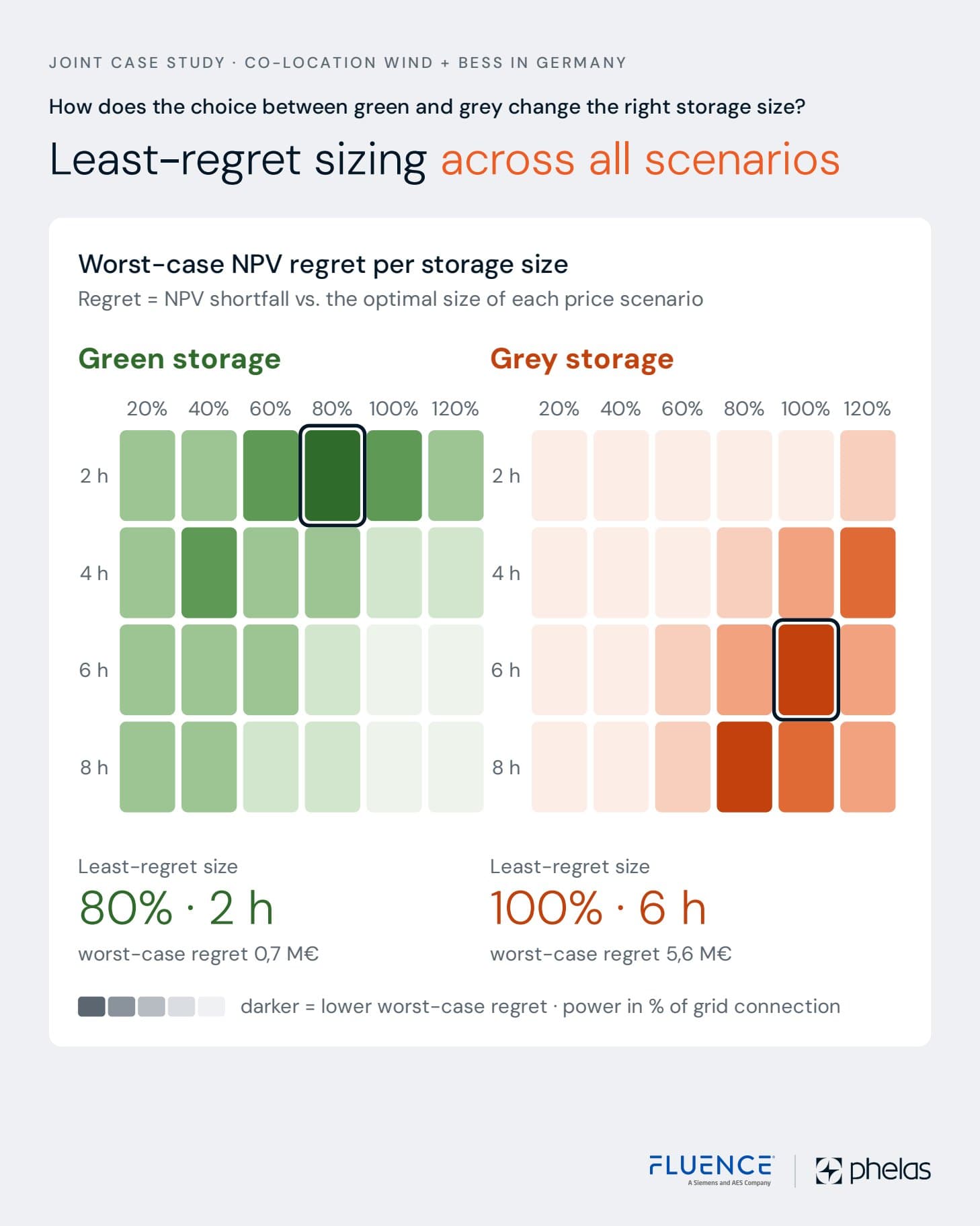
Nobody knows today which price path will come true. So we also looked for the least-regret size, the one that stays closest to the optimum in every scenario. For green storage, that's 80% of the grid connection at 2 hours, never more than 0,7 M€ of NPV behind. For grey storage, it's full power at 6 hours, never more than 5,6 M€ behind.
These results apply to our reference project. Wind park size, generation profile and grid connection differ from project to project, and each of them shifts the optimal size. That's why every project needs its own simulation, based on its own data.
In the last part of this series, we'll look at whether to build green or grey while regulation is still evolving.
The full case study is available here.
Charts from this article
PDF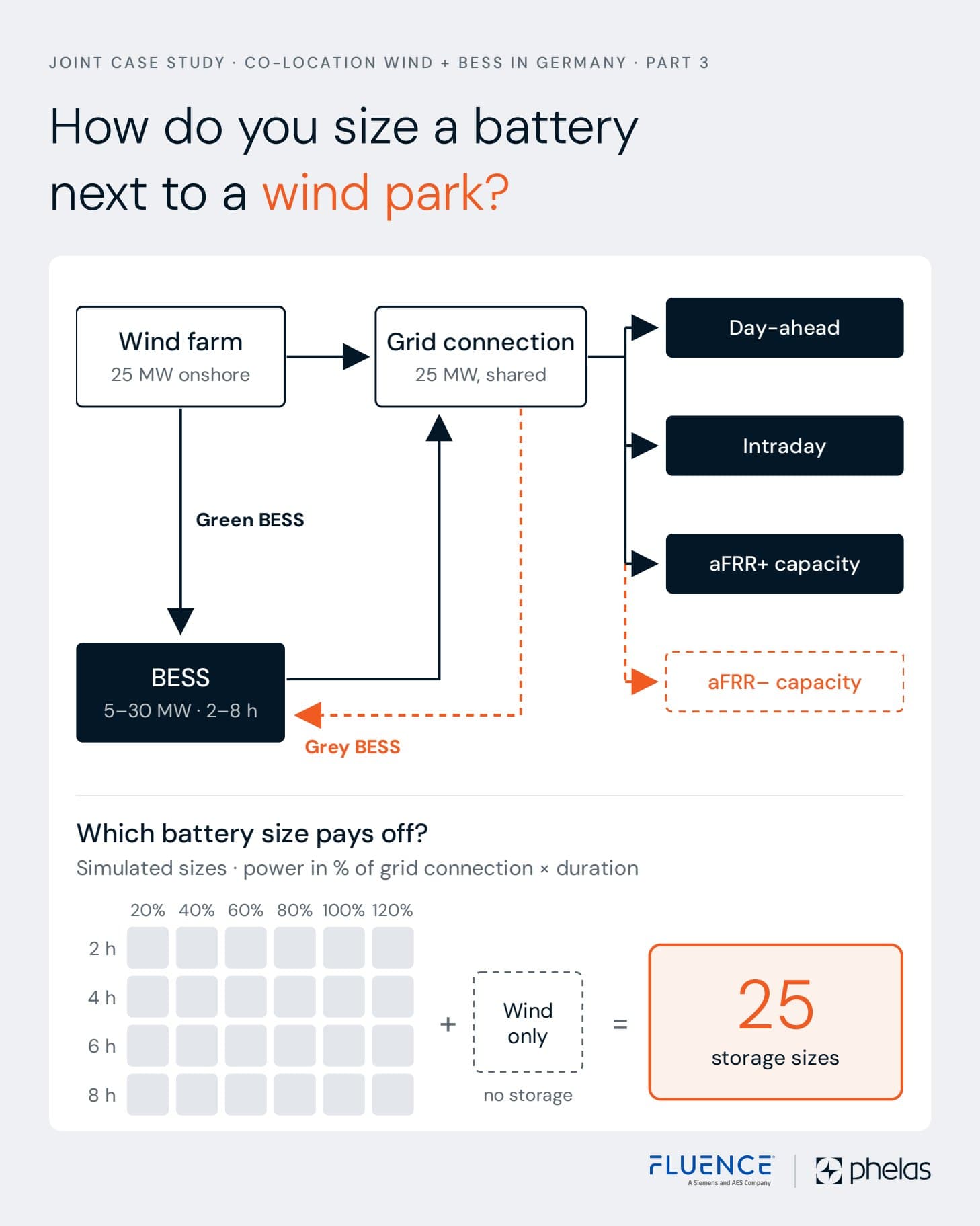
Click a chart to open the PDF.
Model your own projects
Apply the methodology directly to your projects — with personalized scenarios, site parameters, and auditable results.