
Green storage lowers the risk where curtailment is high. Grey storage lowers it in every scenario.

Green storage lowers the risk where curtailment is high. Grey storage lowers it in every scenario.
Many people assume any battery storage makes a wind project safer. In our case study with Fluence, that was only half true.
To see how much risk battery storage really takes out, we ran a 25 MW onshore wind park through five market price scenarios up to 2056, from a coordinated energy transition to one where flexibility can't keep up with renewables. They're stress tests, not forecasts.
In this post, I focus on two risks that these scenarios capture and that directly affect a wind park's revenue. One is a high number of negative-price hours. Germany had a record 573 of them in 2025 and more than 460 so far this year. Under the current rules, new EEG parks get no market premium whenever the day-ahead price turns negative (and the EEG 2027 draft keeps it that way), so they're usually curtailed. The other is a low average market price. Prices are high today, but over a 30-year lifetime, the question is where they'll go as the energy system keeps changing.
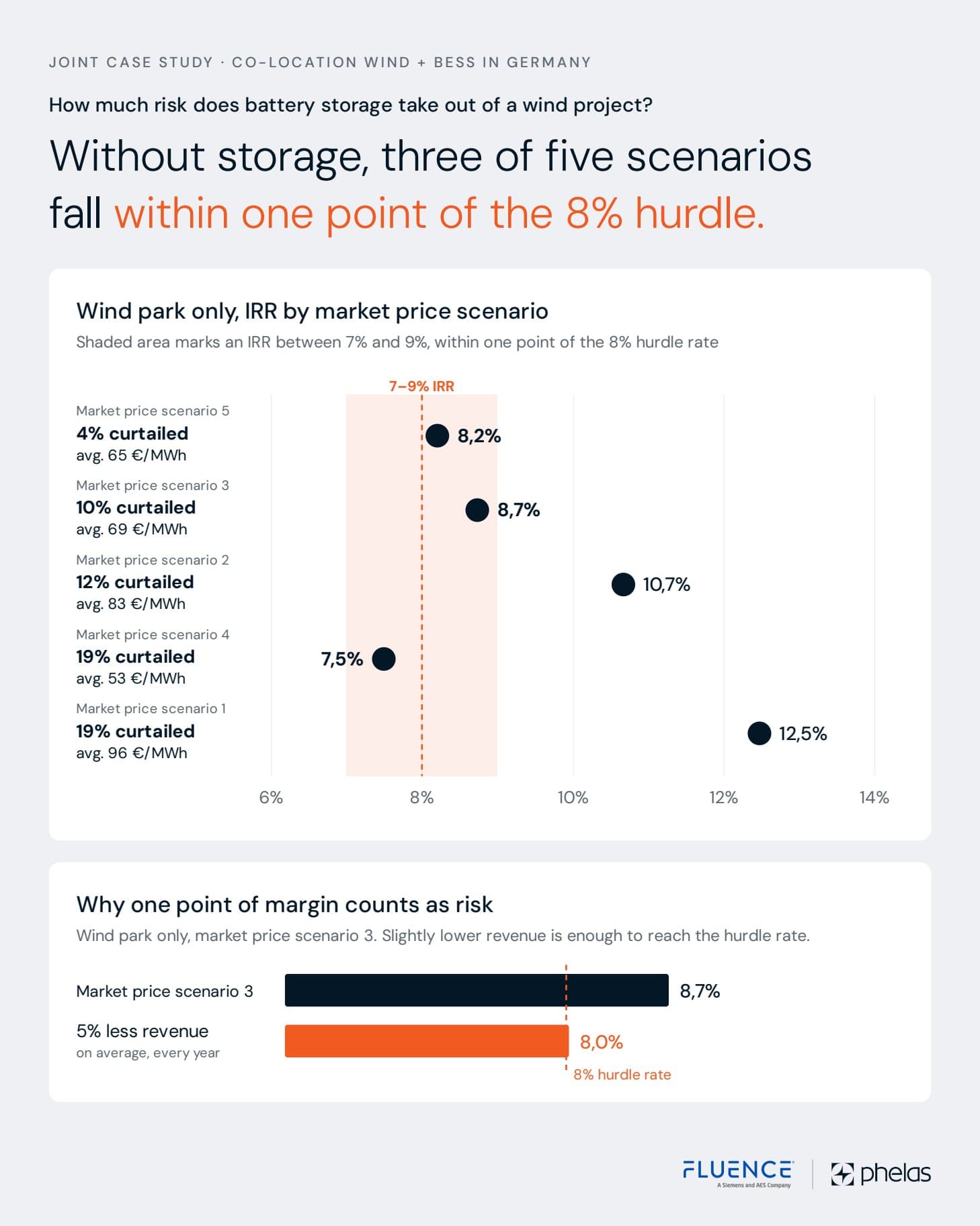
Without storage, three of five scenarios end up less than one percentage point above or below the 8% hurdle rate. In the central scenario (Scenario 3), the park reaches 8,7%. Just over 5% less revenue on average would push it below the hurdle rate.
A green battery storage system works where curtailment is high. Two scenarios show this well. Both have 19% curtailment, but average prices 43 €/MWh apart. Green storage delivers almost the same IRR uplift in both. In the scenario with only 4% curtailment, it adds just 0,2 % points, and the park stays close to the hurdle rate at 8,4%.
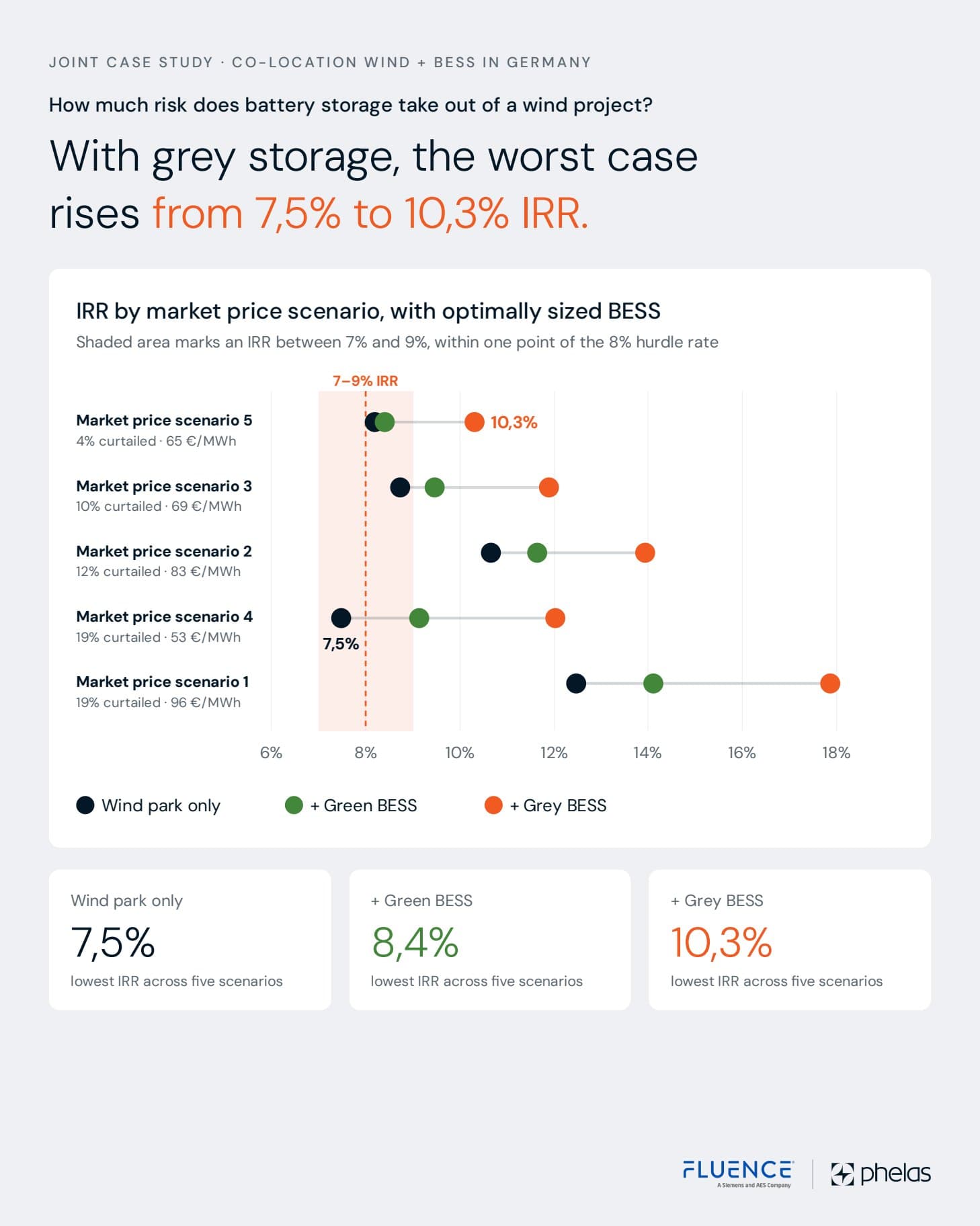
A grey system lifts every scenario clear of the hurdle rate, even the one with low prices and little curtailment, to 10,3%. Across all five scenarios, that's the new worst case, compared with 7,5% for the wind park alone.
In our projects we often see that lenders mainly look at the downside case, because that's what they size the debt on. So for bankability, I think the key question isn't how much storage adds on average, but how much it lifts the worst case. Here, grey storage does about three times as much as green.
One thing surprised me, though. Only a fifth to a third of what the green system stores would otherwise have been curtailed. Curtailment shows where green storage pays off, but most of the value comes from somewhere else. Which markets green and grey storage need to pay off is what I'll look at in the next post.
Charts from this article
PDF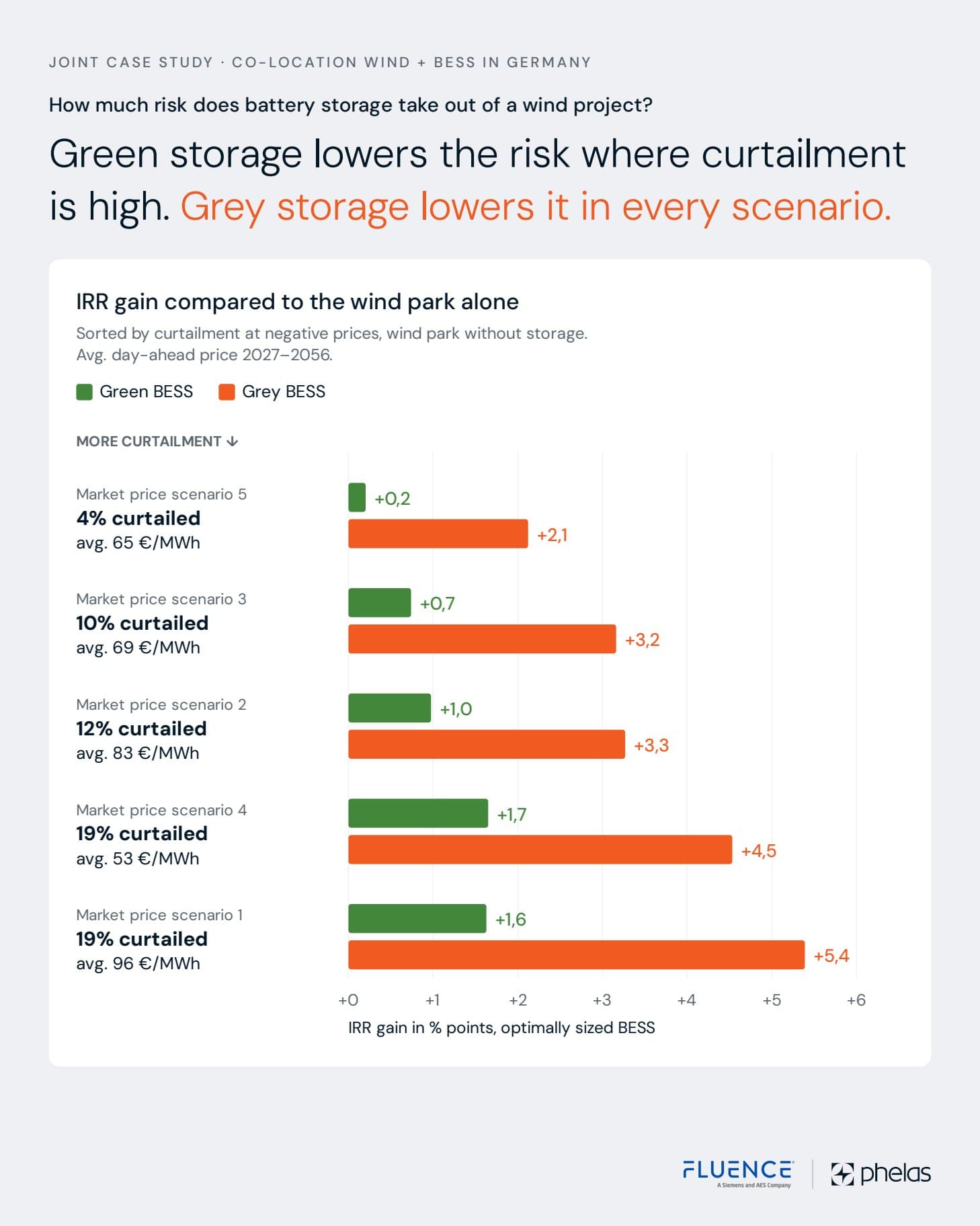
Click a chart to open the PDF.
Model your own projects
Apply the methodology directly to your projects — with personalized scenarios, site parameters, and auditable results.